Abstract concepts are hard to see
Atoms, internal anatomy and complex mechanisms can be difficult to understand through a flat diagram alone.
Use Case / Education
 Education
The Opportunity
Atoms, internal anatomy and complex mechanisms can be difficult to understand through a flat diagram alone.
A life-size skeleton, specialist equipment or a dedicated learning environment may be expensive, unavailable or impractical to bring into every classroom.
Reading information is only one part of learning. Quizzes, discovery and hands-on interaction can give students a reason to apply what they understand.
What AR Makes Possible
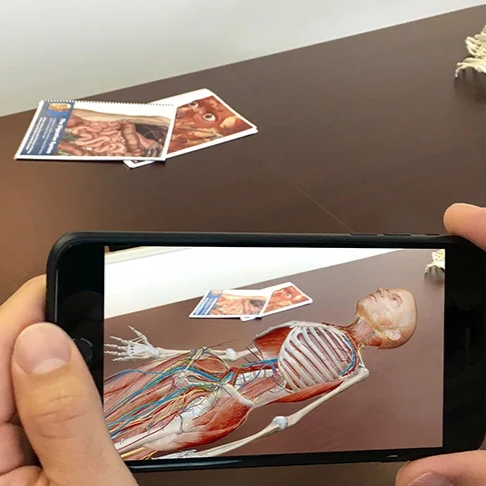
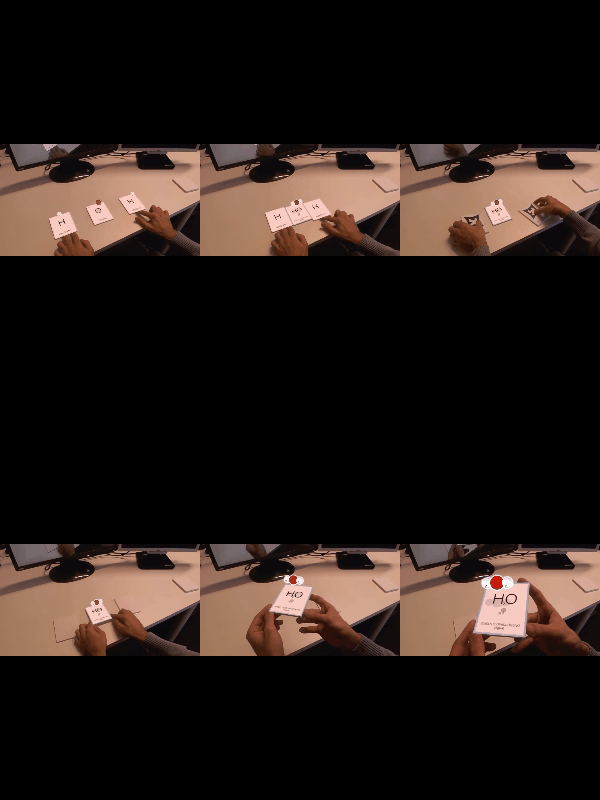
Simple printed cards can reveal three-dimensional learning content, helping students visualise relationships and processes that are too small, hidden or abstract to observe directly in a textbook.
A human skeleton can appear at scale in the room. Students inspect missing bones, learn the relevant anatomy, complete quizzes and unlock the pieces needed to restore the model.
AR can simulate tasks that are expensive, inaccessible or impractical—from learning equipment procedures to planting seeds and caring for virtual plants. The experience can preserve meaningful actions and the passage of time while remaining available indoors.
Here's What We Built
Printed material becomes a trigger for three-dimensional educational content that students can inspect from different angles.
A life-size skeleton and missing-bone challenge combine spatial visualisation with reading, quizzes and repeatable randomised learning.
Explore Other Use Cases
Have an idea for Education?